

Consumer email is costing telcos more than it’s worth. So why are they still running it?
Telco consumer email has become an odd kind of problem. Everyone in the industry knows the service is in decline. The business case for running it has been eroding for years. Yet, telcos are still offering the service, carrying the infrastructure costs, the security risks and the operational overhead of a product that stopped growing a decade or more ago.
How did a service that once helped telcos build customer relationships turn into something they can’t figure out how to leave?
From dial-up staple to stranded asset
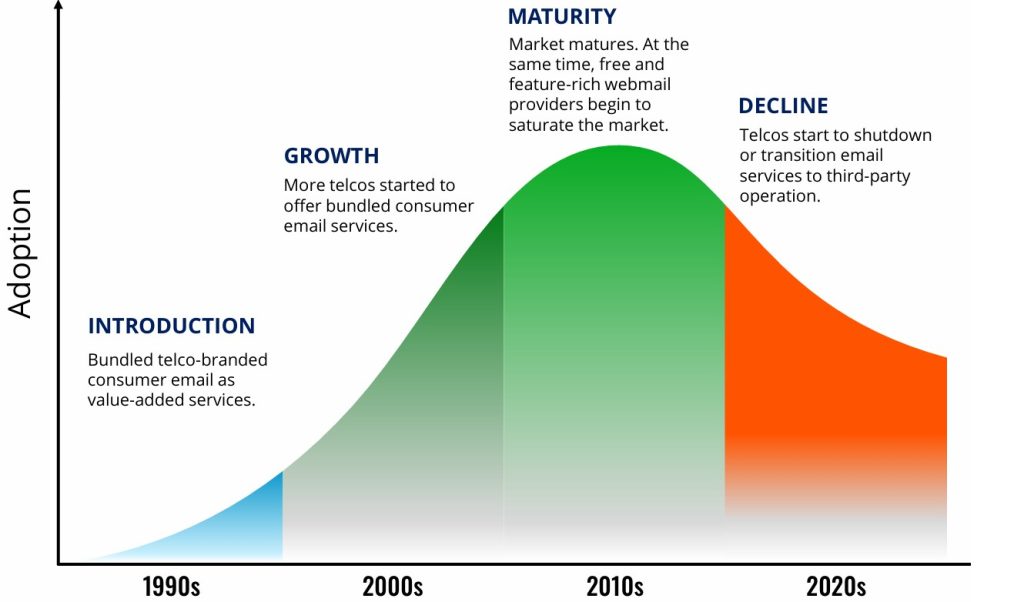
In the early days of the internet, your email address came with your connection. Telcos provisioned millions and millions of mailboxes, customers used them, and for a while the arrangement made sense. Email was the way people communicated online, and your ISP was the only way to get online.
That all started to change when Hotmail launched in 1996, Yahoo Mail in 1997 and Gmail in 2004. Each one raised the bar on what free, portable webmail could offer, from better storage and spam filtering to no lock-in to a provider. By the mid-2000s, the writing was already on the wall for telco-provided email as a competitive product.
By the mid-2010s, most telcos had stopped offering new email account registrations altogether. The subscriber base that remained was ageing, consisting of people who had held the same address for years and had too much tied to it to bother switching. Telco email had become, in effect, a service for customers who hadn’t yet found a reason to leave.
 A cost centre that keeps growing
Across regions and operators, the gap between provisioned mailboxes and accounts that are actively in use is striking. One telco audit conducted in 2025 found that, of 3.2 million provisioned mailboxes, only around a third had been meaningfully accessed. The remaining two-thirds were dormant accounts or ‘ghost inboxes’ generating costs and security exposure with no corresponding value. To make matters worse only about one third of the active one third reported using it as their primary email account. A cost incurred for 3.2 million becomes a service being operated and valued for just 350,000.
For those responsible for capital allocation this is a difficult conversation to avoid. Every dollar spent maintaining legacy email infrastructure is a dollar not going toward network expansion, AI investment or enterprise growth. The costs of infrastructure, security, storage and support are disproportionate to what consumer email returns.
In balance sheet terms, it is not just a cost centre; it is a liability in unmanaged decline.
The security problem is accelerating
Since ChatGPT’s launch in late 2022, malicious phishing emails have surged by 4,151%, according to SlashNext’s 2024 Mid-Year Assessment on The State of Phishing. Telco email estates are particularly exposed because the subscriber base skews older; a demographic that research consistently identifies as more susceptible to phishing scams. The infrastructure is also often under-resourced and likely behind on security patches.
The scale of the problem is visible across the industry. In 2025, more than 444,000 fraud cases were recorded on the UK’s National Fraud Database; the highest annual figure on record, driven in large part by AI-generated phishing emails and targeted scams. Telcos have responded with significant network-level investment in fraud detection. However, these measures protect customers across the whole network; they do not fix the underlying vulnerability of legacy email infrastructure that was already struggling before the threat environment changed.
So why is exiting so hard?
Consumer email addresses are deeply embedded in people’s digital lives, linked to bank accounts, government services, decades of correspondence and subscriptions they’ve long forgotten. Customers who involuntarily lose access to their address have a tendency to take their broadband or mobile plan elsewhere. That churn risk is real, and it has kept many telcos frozen.
A managed exit is possible
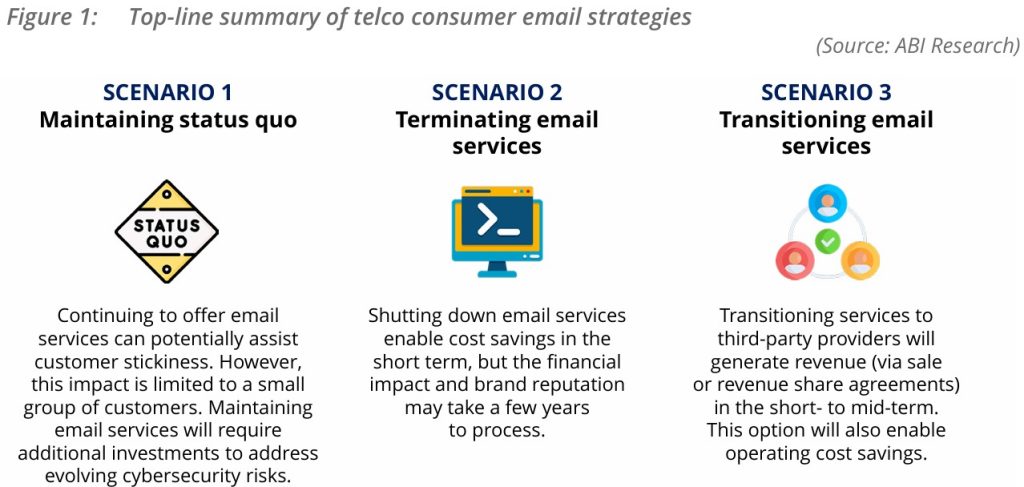
ABI Research identifies three paths for telcos: maintain the service in-house, shut it down or transition customers to a third-party provider. The third option is increasingly the one that makes sense. Done well, it eliminates the infrastructure burden and the security liability while giving customers what they actually care about – keeping their email address on a platform that works.
Consumer email’s decline is not a surprise, and it’s not reversible.
The question for telcos is no longer whether to act; it’s whether they choose the terms of their own exit. The telcos that will look back on this decision most favourably are the ones who made it before they had to.